Every city holds several versions of itself. In Cartagena, some survive in its streets and squares; others are found in archives, family photographs and the memories of those who knew a city with different rhythms, means of transport and ways of meeting.
In the late 19th century and for much of the 20th, Cartagena went through transformations that redefined its urban landscape and the daily life of its people. The gates that connected the city to the mainland, the popular markets and the railway are all part of that story, which begins in Getsemaní, Cartagena’s first neighborhood. Revisiting these memories is a way of discovering how Cartagena has evolved while continuing to build its identity.
The Media Luna Land Gate
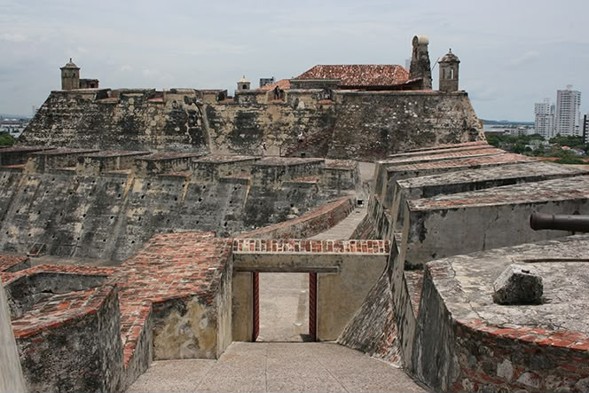
For centuries, one of the main land entrances to the city was the Media Luna Land Gate, in the Getsemaní area. From there, the walled city connected with the roads leading to the mainland. The structure was part of the defensive system that regulated access and protected the boundaries of the city we now know as La Heroica.
In 1893, amid the urban transformations of the time, the bastions of Santa Teresa and Santa Bárbara, which were part of that gate, were demolished. The structure no longer survives, but its name lives on in Media Luna Street, a reminder of the city that once lay beyond its walls.
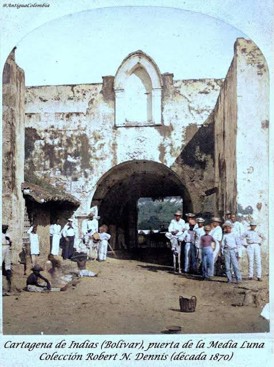
Media Luna Gate, Cartagena de Indias, 1870s. Robert N. Dennis Collection.
Plaza de los Coches
A few streets away, Plaza de los Coches also tells a story of transformation. Before becoming one of the busiest spots in the Historic Center, it was a stage for trade and carriage traffic, when horse-drawn coaches were a regular part of urban mobility. In that setting stood a former seat of the Alcaldía Mayor (Mayor’s Office), which disappeared after the riots of April 9, 1948. Today, beneath the Clock Tower, the plaza continues to bring together locals, merchants and visitors, even though the dynamics around it are different.
Getsemaní Public Market (1904–1978)
Cartagena’s commercial life also had one of its main stages in Getsemaní. Opened in 1904, the Public Market was for decades an essential point for supplying the city. Vendors, fishermen, carriers and shoppers all met there, making the market much more than a place to buy food: it was a space for everyday exchange and encounter.
As Cartagena grew, commercial needs changed and, in 1978, activity moved to Bazurto. The old building was demolished and the current Cartagena de Indias Convention Center was built in its place. In Getsemaní, even street names tell stories, like the two versions of the origin of Tripita y Media Street. And another trace of a different era still stands: a bridge crossing Calle de la Sierpe, a remnant of a former factory in the neighborhood.
The Cartagena–Calamar Railway (1894–1951)
In those years, Cartagena was also connected to other regions by rail. The Cartagena–Calamar line, built in the late 19th century, made it easier for decades to move passengers and goods between the city and the trade routes of the Magdalena River. La Matuna station witnessed the arrival and departure of the locomotives that were part of the urban and economic movement of the time.
Changes in transport networks reduced the importance of this connection and, according to the Bank of the Republic of Colombia (Banrepcultural), rail service was suspended in 1951. Images of that station make it possible to reconstruct a time when the train held an important place in life in Cartagena.
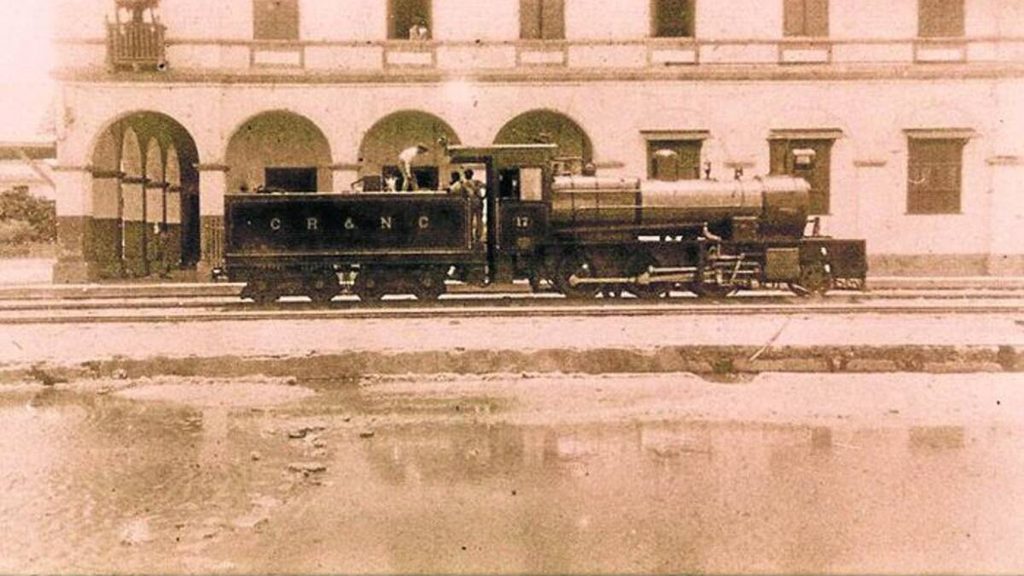
Locomotive of the Cartagena–Calamar Railway at La Matuna Station, Cartagena de Indias, 1926. Photograph: Historical Photographic Archive of Cartagena.
A City That Changes With Its Needs
The old Media Luna Land Gate, Plaza de los Coches, Getsemaní’s market and the Cartagena–Calamar railway belong to different moments, but they share a story: that of a city that has changed with its needs, its commercial activities and its ways of connecting with the world.
Getting to know these places means looking beyond today’s landscape and recognizing the different stages that have shaped Cartagena.
Frequently Asked Questions
Which historic places in Cartagena have changed over time?
They include the old Media Luna Land Gate, Plaza de los Coches, Getsemaní Public Market and the La Matuna railway station.
What happened to Getsemaní’s old market?
Its commercial activity moved to Bazurto in 1978 and the building was demolished. Today, the Cartagena de Indias Convention Center stands on that site.
What happened to the Media Luna Gate?
In 1893, the bastions of Santa Teresa and Santa Bárbara, which were part of the Media Luna Land Gate, were demolished. It was one of Cartagena’s main land entrances, in Getsemaní. Its name lives on in Media Luna Street.
Until when did the Cartagena–Calamar railway operate?
According to Banrepcultural, rail service was suspended in 1951, after several decades of connecting Cartagena with Calamar and the trade routes of the Magdalena River.
Where was Cartagena’s railway station?
The station was in the La Matuna area, where trains on the Cartagena–Calamar line arrived and departed.
Why is it worth learning the history of these places?
Because it helps us understand how Cartagena’s urban landscape, commerce and ways of life have evolved, and discover the stories that continue to give meaning to the city today. For more stories, visit the OSH Hotel blog.